Open to AI research-engineering & applied-science roles

Leuven, Belgium

tristanengelborghs@icloud.com

AI engineer · Leuven, Belgium

Hi, I’m Tristan
Engelborghs.

I build machine-learning systems, from brain signals to robot behaviour. I’m a KU Leuven AI graduate who likes taking a problem all the way from an idea to something that works.

My work spans epilepsy research, robot learning and computer vision. Away from the keyboard, I teach scuba diving — and sometimes bring a little engineering back from the reef.

Open to AI research-engineering & applied-science roles.

01 / Featured research · KU Leuven

A clearer picture
of epilepsy.

From intracranial recordings to interpretable predictions. My master’s thesis explores where seizures begin, and how the model’s ranking relates to seizure freedom after surgery.

Localisation / mean AUROC0.878

Leave-one-patient-out evaluation on 13 seizure-free patients from UZ Gent.

Localisation / mean AUPRC0.835

Precision–recall performance for the same patient-wise channel-ranking task.

Surgical outcome / AUROC0.86

Resection Alignment Score as the sole predictor of seizure freedom in the 20-patient Gent cohort.

My contribution

From brain networks
to surgical insight.

I developed a pipeline combining signal features with connectivity and graph measures, then ranked electrode channels using a soft-voting ensemble of SVM, random forest, LDA, logistic regression and XGBoost models.

I also introduced the Resection Alignment Score (RAS): an interpretable measure of how closely the tissue removed during surgery matches the channels ranked highest by the model.

Data from UZ Gent, with additional feature analysis on the public HUP dataset. The headline model results shown here are from Gent.

Discuss the research
What I found

Connectivity carries the signal.

  1. 01

    Network features were most informative. wPLI-based connectivity, phase–amplitude coupling and approximate entropy stood out in the feature analysis.

  2. 02

    A compact model was enough. Five selected features achieved 0.878 mean AUROC. Feature-set variants did not differ significantly after correction.

  3. 03

    Alignment relates to outcome. Higher RAS values were associated with seizure freedom, while individual exceptions showed the limits of localisation alone.

The result behind the averageAll 13 patients · localisation AUROC
P0011.000
P0020.970
P0030.048
P0040.986
P0050.995
P0060.977
P0071.000
P0080.913
P0090.856
P0100.979
P0110.929
P0120.989
P0130.767

Mean 0.878; individual values range from 0.048 to 1.000. Resection in seizure-free patients serves as a proxy for epileptogenic tissue.

View exact results and evaluation details
PatientAUROCAUPRCP@k
P0011.0001.0001.000
P0020.9700.8530.800
P0030.0480.1960.000
P0040.9860.9170.667
P0050.9950.9750.875
P0060.9770.9090.750
P0071.0001.0001.000
P0080.9130.9680.882
P0090.8560.5750.667
P0100.9790.8980.714
P0110.9290.8750.857
P0120.9890.9890.889
P0130.7670.7000.615

Soft-voting ensemble, leave-one-patient-out validation. Source: master’s thesis, §4.2, Table 4.1, p. 21. P003 is retained in the reported mean.

When is the signal most useful?Mean localisation AUROC by time-window configuration
Peri-onset · final model0.878
Pre/post-onset0.873
Interictal0.821
Pre/post-onset + interictal0.876
Pre/post-onset + interictal + offset0.883

The peri-onset model is the final baseline. Broader windows reached 0.883, but differences were not statistically significant after Holm correction. Source: Table 4.4, p. 25.

Reading these results

These are retrospective research results from a small cohort. Performance varied substantially between patients; the resected region is an imperfect reference for the epileptogenic zone.

Outcome result: §4.6, p. 28. Study limitations: §5.3, p. 33.

02 / Robot learning · Vision-language-action

A 500M VLA on LIBERO-Goal.

I turned the SmolVLM2-500M vision-language model into a robot policy. It reads two camera views and a natural-language instruction, then outputs a chunk of continuous arm actions.

LoRA adapters on the language model's attention train 4.8M of its 465M parameters. Eight learned action queries feed a small regression head, following the OpenVLA-OFT recipe inside my own benchmark harness. It is compared with a 27M ResNet-FiLM policy trained from scratch, on the same 500 initial states.

VLA success
91.0%95% CI 88.4–93.4
From-scratch baseline
85.0%27M parameters
Paired difference
+6.0 ppp = 0.0014, 500 episodes
Instruction removed
0.4%language carries the task
Success rate per taskLIBERO-Goal, 50 episodes per task on identical initial states, seed 0
  • VLA (SmolVLM2 + LoRA)
  • Baseline (27M, from scratch)
Show as a table
  1. 01

    How it was measured

    One NVIDIA L4 GPU and a pinned LIBERO commit. Each model ran 50 episodes per task on the same initial states, and the difference is tested with a paired sign-flip permutation test. Language ablations destroy the instruction at evaluation, or in training as well.

  2. 02

    What it showed

    On Goal, the instruction is nearly everything: without it both models fall to or below the 1-in-10 guess rate. The VLA gains most where the baseline struggles (pushing the plate: 72% to 100%) and loses on the two-stage drawer-and-bowl task. Pretraining bought six points for 4.6× the GPU-hours.

  3. 03

    A bug worth finding

    LIBERO spells four of the ten Goal instructions differently in its demonstration files and its evaluator, so the baseline had been training on one instruction and rolling out on another. Training now reads each instruction exactly as the evaluator does.

Single training seed. I treat these numbers as preliminary until they replicate over at least three seeds. The from-scratch baseline already beats the published from-scratch reference on Goal (Diffusion Policy, about 68%).

03 / More robot learning

Hands, arms and simulators.

Self-directed projects that each take one part of the manipulation problem. Same habits throughout: per-episode results on disk, ablations run in training and evaluation alike, and tests that run without a GPU.

    • MuJoCo
    • PPO
    • DAgger
    • Touch sensing

    Dexterous in-hand manipulation

    A Shadow Hand (24 joints, 20 actuators, tendon-coupled finger joints) reorients a cube through intermittent contact. I built the environment, domain randomisation, fingertip touch sensing and a threaded simulator (about 1,700 control steps per second on an M1 laptop). A PPO teacher trains on privileged state; a DAgger student sees only proprioception, touch and the goal.

    Clip: the first four evaluation episodes, unselected (0, 2, 0 and 5 goals). Over 200 episodes the policy averages 1.2 goals per 5 seconds, against 0.34 for random actions.

    • Computer vision
    • MediaPipe
    • Imitation

    Robot demonstrations from human video

    This pipeline films a person doing a task and turns the video into robot demonstrations in LIBERO's format. It tracks the hand, fits the palm pose with Kabsch alignment, smooths it with a 1-Euro filter that coasts through occlusions, and retargets it to end-effector actions on the robot's 20 Hz control clock.

    Clip: the pipeline on a synthetic hand with landmark noise and a scripted occlusion, so no person is filmed.

    • Isaac Lab
    • Diffusion policy
    • In progress

    Learning from demonstration in Isaac Lab

    Teaching a Franka arm to grasp and lift blocks from demonstrations: keyboard and gamepad teleoperation, differential IK, HDF5 demos validated by replaying them to success, and diffusion-policy imitation alongside PPO. Everything runs from my laptop over ssh into a containerised Isaac Lab on a rented GPU; I patched three Isaac Lab 3.0.0 bugs on the way.

    Clip: dozens of arms simulated in parallel at the start of a PPO run. A sibling project, throw-and-catch on a palm-up Shadow Hand, keeps its task logic in tested NumPy with a GPU-batched twin checked by a parity test.

Side project

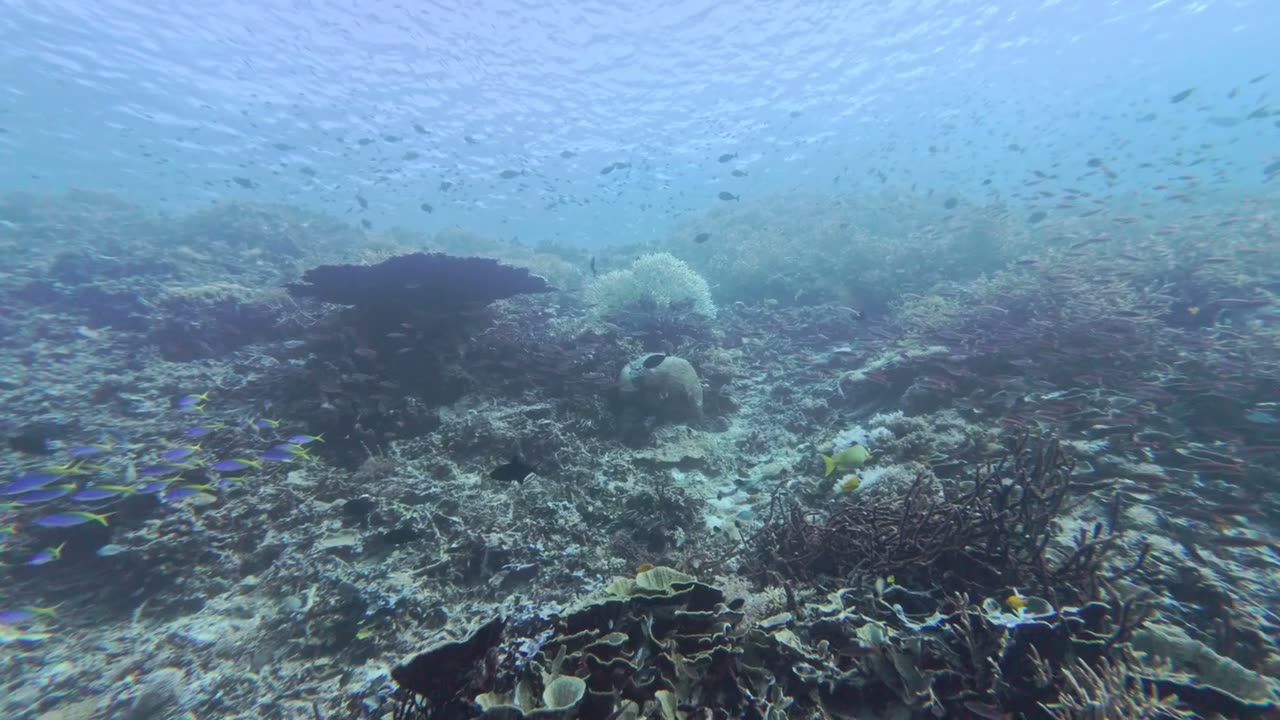
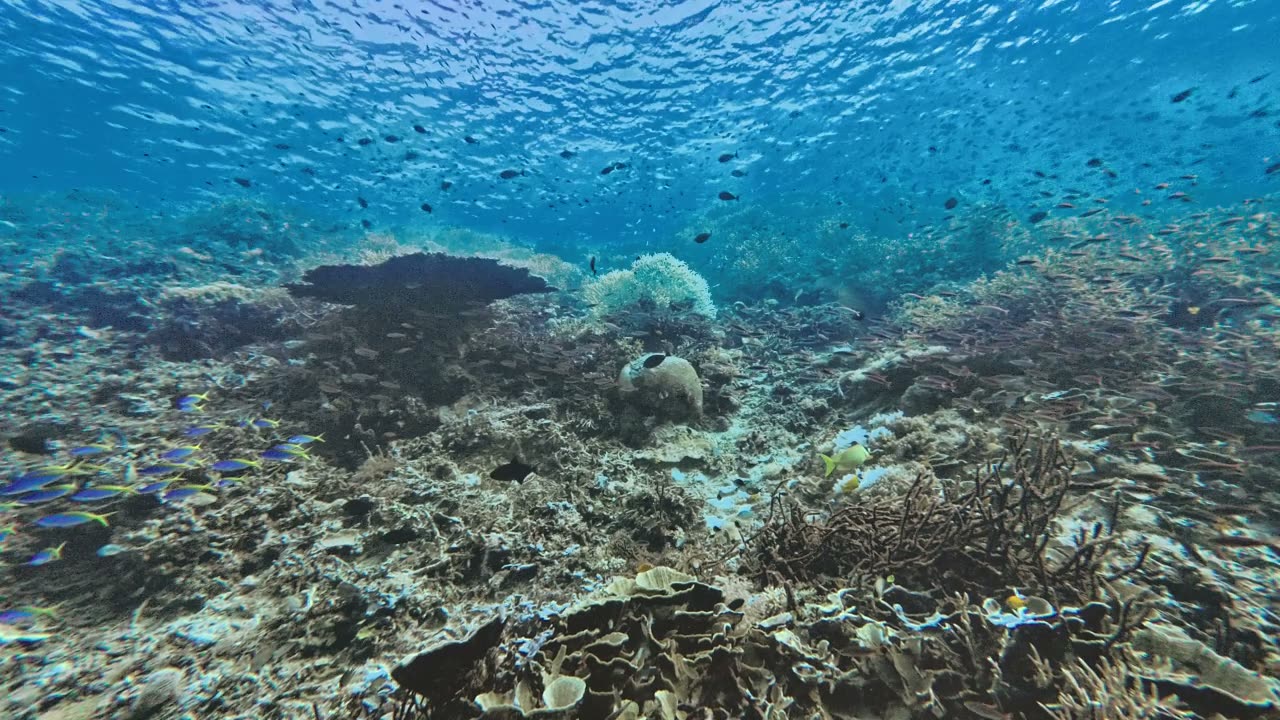
Restoring underwater video.

As a dive instructor I film on the reef, where water scatters and absorbs light and footage turns flat and blue with depth.

Each frame gets veil (backscatter) removal in linear light, driven by a dark-channel estimate of how much light survived, then local contrast and light sharpening. A 3-D colour lookup table fitted to one AI-edited reference frame is then applied to the whole 4K clip with FFmpeg.

On held-out pixels the error to the reference fell from 0.160 to 0.055, and the output-to-input brightness ratio moves by at most 0.007 between frames, so the grade doesn't flicker.

  • Python
  • NumPy & OpenCV
  • FFmpeg
  • 3-D LUTs
Coral reef as filmed: hazy, flat and blue-grey The same frame restored: clear blue water and visible coral colour and detail

About

Engineer, diver, builder.

I'm an AI engineer from Leuven, Belgium. I finished my MEng in Artificial Intelligence at KU Leuven in 2026, after a BSc in Engineering Sciences with a computer-science major and an electrical-engineering minor.

I like owning a problem end to end, from data to model to evaluation to the tool someone actually uses, and I'm at my best in a driven team working on hard problems in robotics, science or health. I also teach scuba diving, which taught me to explain things clearly and calmly when it matters.

Languages

  • Dutch native
  • English full professional
  • French limited working

Skills

Machine learning

  • Transformers & VLAs
  • LoRA fine-tuning
  • Diffusion policies
  • RL (PPO)
  • Imitation learning
  • Graph neural networks
  • Masked autoencoders
  • Multiple-instance learning

Robotics & simulation

  • MuJoCo
  • Isaac Lab / Isaac Sim
  • robosuite & LIBERO
  • Differential IK
  • Teleoperation
  • MediaPipe

Engineering

  • Python
  • PyTorch
  • NumPy & pandas
  • MNE
  • MATLAB
  • Git
  • Linux
  • Docker
  • SLURM
  • FFmpeg

Education

  • 2024 – 2026

    MEng in Artificial Intelligence

    KU Leuven

    Machine learning, deep learning, reinforcement learning, robot AI, brain–computer interfaces, bioinformatics, image analysis, big-data analytics and neurosymbolic AI.

  • 2021 – 2024

    BSc in Engineering Sciences

    KU Leuven

    Major in computer science, minor in electrical engineering.

Experience

  • Research

    Master's thesis researcher

    KU Leuven · epilepsy surgery, intracranial EEG

    End-to-end machine-learning workflow for a two-centre clinical study, plus a research application for clinicians.

  • Freelance

    Web developer

    Client projects

    Designing and delivering client websites on my own: UX/UI, accessibility, SEO and project management.

  • Diving

    NAUI scuba diving instructor

    Open and confined water

    Training students with an emphasis on safety, leadership and clear communication.